ArtLingua Article
Art Lessons for Large Chinese Public School Classes (40–50 Students)
Master large ESL class art activities in Chinese public schools. Practical lesson plans for foreign teachers in China tackling 40 to 50 students.
Art Lessons for Large Chinese Public School Classes (40–50 Students)
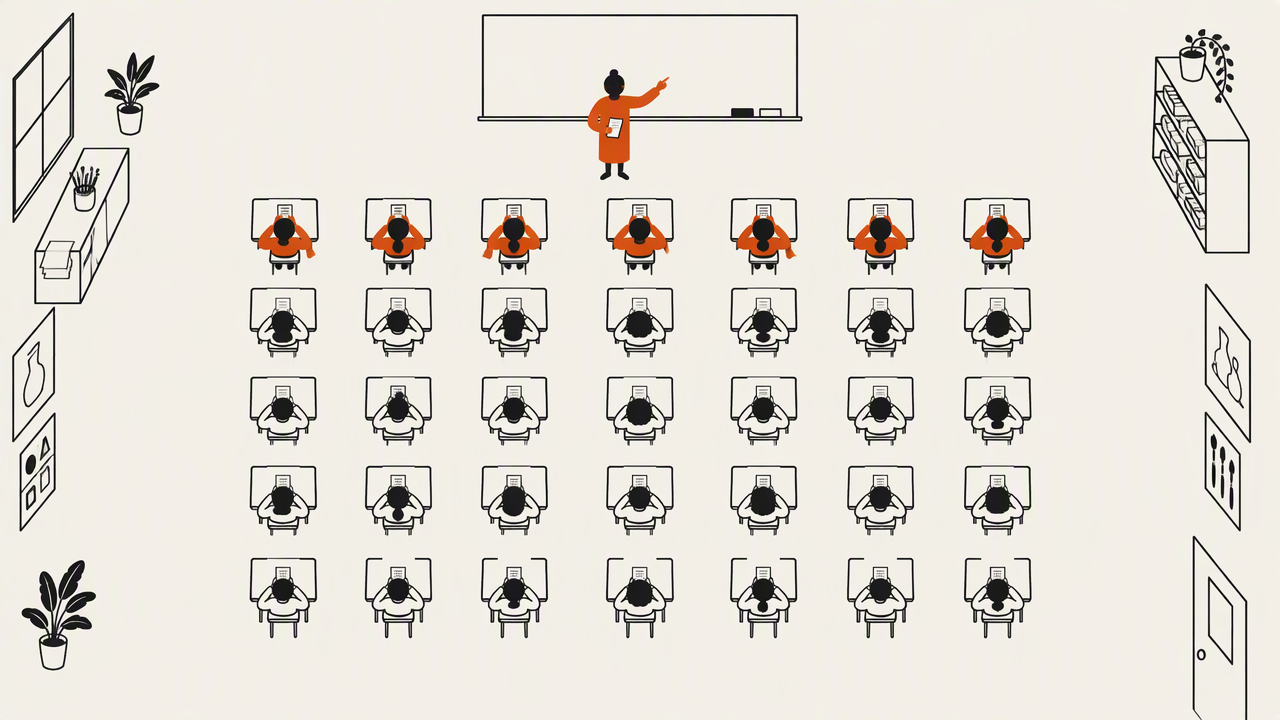
When teaching English in Chinese public schools, walking into a classroom for the first time can be an eye-opening experience. Instead of a small seminar group of ten seated around a craft table, you are met with forty-five to fifty-five students seated in tight, parallel rows of wooden desks. Aisles are narrow, physical supplies are often sparse, and you have exactly forty or forty-five minutes to deliver meaningful English language input while guiding a hands-on project.
Finding practical lesson plans for foreign teachers in China that account for these physical constraints is notoriously difficult. Generic international art lessons assume dedicated sinks, infinite paper, and spacious studio layouts. In reality, large ESL class art activities require rigid logistical choreography, disciplined material distribution, and high-engagement language routines.
This guide provides a field-tested blueprint for running high-impact, low-chaos art and English lessons in high-density Chinese classrooms.
Managing High-Density Seating and Shared Material Stations
The physical environment of a standard Chinese public school classroom dictates what is possible. Desks are typically arranged in paired columns (often four double-rows across the room). Aisles barely accommodate a single adult walking through, making individual material hand-outs an immediate failure point.
If you attempt to distribute fifty individual pairs of scissors or fifty glue sticks one by one, you will consume twelve to fifteen minutes of your forty-five-minute period before instruction even begins.
+-------------------------------------------------------+
|                    TEACHER PODIUM                     |
+-------------------------------------------------------+
      [Aisle 1]             [Aisle 2]             [Aisle 3]
  Row 1: [Desk 1-2]     Row 1: [Desk 3-4]     Row 1: [Desk 5-6]
  Row 2: [Desk 1-2]     Row 2: [Desk 3-4]     Row 2: [Desk 5-6]
  Row 3: [Desk 1-2]     Row 3: [Desk 3-4]     Row 3: [Desk 5-6]
  Row 4: [Desk 1-2]     Row 4: [Desk 3-4]     Row 4: [Desk 5-6]
1. Leverage the Group Leader (Xiaozu Zhang) Protocol
Chinese classrooms already run on an internal student hierarchy. Every row or group of four to six desks has an appointed group leader (Xiaozu Zhang / 小组长). Instead of fighting the existing structure, lean into it directly:
- Before class begins, place pre-packed "Supply Trays" (plastic baskets or even recycled cardboard lids) at the front desk of each column.
- Train the row leaders to stand, collect one basket for their four-desk pod, and return immediately.
- Establish a strict rule: Hands off until the countdown finishes. When the basket arrives at the desk pod, students must keep their hands on their laps until you give the verbal and visual clearance.
2. Implement the Shared Island Rule
In a fifty-student room, individual supply allocation leads to dropped items, floor clutter, and lost time. Instead, configure desks into shared supply islands:
| Material Type | Allocation per 4-Student Pod | Distribution Strategy |
|---|---|---|
| Pencils / Markers | 1 central cup (8–10 colors) | Placed dead center between paired desks |
| Scissors | 2 pairs per 4 students | Students alternate cutting and folding tasks |
| Glue Sticks | 2 sticks per 4 students | "Cap click" routine after every application |
| Paper Stock | Exact count (4 sheets) | Handed out by front-row student backward |
If your assigned classroom has zero art supplies available on a given week, you do not have to cancel your creative session. You can transition smoothly using Empty Room Mode: Zero-Prep, No-Supply Art & English Lesson Generator to run structured drawing, origami, or gesture-based visual language tasks using only standard student notebook paper and pencils.
Choral Response and Partner Talk During Art Creation
One of the greatest traps when designing art lesson ideas for Chinese classrooms is the silence trap. When students begin drawing or cutting, the room either falls into dead silence (yielding zero spoken English output) or explodes into chaotic native-language chatter.
In a class of fifty, individual speaking turns are mathematically ineffective. If every student speaks for fifteen seconds, your entire lesson is over. You must rely on rhythmic choral structures, call-and-response framing, and structured peer micro-dialogues.
Rhythmic Choral Checkpoints
Integrate rhythmic call-and-response directly tied to physical art actions. This keeps forty-five students focused on target vocabulary while their hands work:
- Teacher Action Prompt: Hold up a blue crayon. "What line do we make? Zig-zag!"
- Whole-Class Choral Echo: "Zig-zag blue line!" (Students immediately draw three zig-zag lines on their paper).
- Pencil Down Callout: Teacher claps twice: "One, two, pencils down." Class echoes: "Three, four, eyes on you."
Teacher: "Draw a curved line!" (Holds arm up in an arch)
Class:   "Curved line!" (Students draw arch, echoing simultaneously)
Teacher: "What color is your contour?"
Class:   "It is [Target Color]!"
Scaffolding for Mixed-Proficiency Megaclasses
In any large public school grade, student English proficiency varies wildly. If you demand complex sentence structures from low-confidence students during an active art task, they will freeze or disengage.
Applying Tier-Aware ESL Scaffolding: Tailoring Art Vocabulary for Tier 1, 2, and 3 Learners ensures that Tier 1 (absolute beginner) students can participate via physical pointing and single-word choral echoes, while Tier 2 and Tier 3 students are prompted to use full descriptive phrases during partner check-ins.
           [ Tier 1: Non-Verbal & Single-Word ]
           - Point to "Rough" / Echo "Red"
                          │
                          ▼
           [ Tier 2: Framed Sentence Stems ]
           - "I use a [straight line] for the roof."
                          │
                          ▼
           [ Tier 3: Independent Description ]
           - "My building has geometric patterns and warm colors."
Step-by-Step Lesson Workflow for 45-Minute Mega-Classes
Time management is the single biggest point of failure in large-class environments. Without a deterministic, timed schedule, a teacher will spend twenty minutes explaining instructions, leaving only ten minutes for production and zero minutes for collection.
To maintain control, use a standard four-phase workflow optimized for forty-five-minute blocks:
[00:00 - 08:00]  PHASE 1: Extraction & Input (High energy, whole-class drill)
[08:00 - 15:00]  PHASE 2: Modeling & Material Staging (Visual silent demo)
[15:00 - 35:00]  PHASE 3: Timed Production & Choral Checkpoints (Hands on)
[35:00 - 45:00]  PHASE 4: Staged Clean-Up & Visual Assessment (Exit ticket)
Phase 1: Extraction & Target Input (0:00 – 8:00)
- Objective: Introduce 3–4 target vocabulary words (e.g., Horizontal, Vertical, Overlap, Contrast).
- Technique: Total Physical Response (TPR) paired with flashcard extraction. Have all fifty students stand. When you say "Vertical," they reach high. When you say "Horizontal," they spread their arms wide.
- Fast-paced repetition ensures full physical engagement before anyone touches a marker.
Phase 2: Teacher Modeling & Pass-Out (8:00 – 15:00)
- Crucial Rule: Never talk while distributing materials. Deliver your instructions first, verify comprehension, and only then trigger material movement.
- Do a Silent Demonstration on the chalkboard or document camera. Exaggerate physical movements.
- Run a sixty-second comprehension check using concept questions: "Do we cut the red line or the black line? Show me one finger for red, two fingers for black."
- Trigger the Group Leader distribution protocol.
Phase 3: Active Creation with Micro-Drills (15:00 – 35:00)
- Divide the twenty-minute production window into two distinct ten-minute milestones.
- Milestone 1 (15:00 – 25:00): Structural drawing / line work. Stop the room at minute twenty-five for a 30-second peer show-and-tell: "Turn to your desk partner. Point and say: Look at my [Element]."
- Milestone 2 (25:00 – 35:00): Color fills and texture accents. Walk the perimeter aisles to monitor safety and spot-check target language.
Phase 4: Staged Clean-Up & Rapid Assessment (35:00 – 45:00)
Clean-up with fifty children cannot happen simultaneously without desks tipping and supplies scattering. For an in-depth breakdown of row-by-row collection procedures, read our guide on Class-Size-Aware Clean-Up Staging: Chaos-Free Art Logistics for Any Room Size.
- Minute 35–38: Row 1 & 3 collect scissors/glue back into central trays; Row 2 & 4 cap all markers.
- Minute 38–41: Row leaders return trays to the front podium. Desks must be completely clear except for the completed artwork.
- Minute 41–45 (Rapid Assessment): All students hold their artwork at chest height facing forward. The teacher calls out a target descriptor (e.g., "Show me warm colors!"). Students whose artwork matches raise their work above their head and shout the choral confirmation.
3 Practical Art Lesson Ideas for Chinese Classrooms
When selecting projects for large ESL class art activities, prioritize projects with low tool variety and high visual clarity.
1. The Architectural Silhouette (Line & Texture Focus)
- Language Focus: Tall, short, geometric, triangle, rectangle, skyline.
- Required Gear: Black marker, white A4 paper, standard ruler (or edge of textbook).
- Execution: Students draw an imaginary city skyline using geometric shapes. They must include at least three tall rectangles, two triangles, and five horizontal lines.
- Why it works in mega-classes: Zero liquid supplies, zero scissors needed. Students utilize existing pencil-case tools while internalizing spatial English prepositions (above, next to, between).
2. Symmetrical Folk Masks (Shape & Emotion Focus)
- Language Focus: Symmetry, angry, joyful, fierce, left, right, mirror.
- Required Gear: Half-sheet colored construction paper, pencil, safety scissors, glue stick.
- Execution: Students fold paper down the center line, sketch half a face, cut features, and flip the cutouts outward to create positive/negative symmetrical contrast.
- Why it works in mega-classes: Paper scraps remain attached to the outer border, dramatically cutting down floor litter.
+-------------------+-------------------+
|     ORIGINAL      |     MIRRORED      |
|     HALF-FOLD     |      CUT-OUT      |
|                   |                   |
|       ( | )       |       ( | )       |
|      <--|-->      |      <--|-->      |
|                   |                   |
+-------------------+-------------------+
 Fold down center -> Cut shape -> Flip outward
3. Texture Frottage Monsters (Sensory & Adjective Focus)
- Language Focus: Rough, smooth, bumpy, grid, pattern, rub.
- Required Gear: Standard pencil, thin scrap paper, classroom environment textures (wall brick, desk edge, sole of shoe, coin).
- Execution: Students place paper over physical textures around their immediate seating space and rub with the side of a pencil lead to capture textures, assembling them into an imaginary creature.
- Why it works in mega-classes: Requires no liquid paint or messy pastes. Students remain in their immediate desk zone while physically interacting with adjectives.
Eliminating Prep Stress with Timed Lesson Generators
Creating balanced, minute-by-minute plans that account for fifty students, minimal supplies, and strict language targets can consume hours of your weekly planning time.
Foreign teachers often get caught guessing how long an activity will take or struggle to adapt generic online craft ideas into realistic public school environments.
Using the Free AI ESL Art Lesson Plan Generator: Create Custom Timed Plans in Minutes, you can enter your exact student headcount, room layout constraints, available materials, and grade level. The engine generates structured, printer-friendly lesson blueprints complete with Tier-specific scaffolding scripts and class-size-aware clean-up protocols.
You can try the EEEEK! generator directly to instantly produce a custom, timed plan tailored to the exact realities of your Chinese school classroom.
Frequently Asked Questions
How do I handle students speaking Chinese during art production time?
Do not attempt to penalize native language use entirely during high-focus physical tasks like cutting or measuring. Instead, introduce structured English checkpoints every four to five minutes. Ring a chime or use a clap-rhythm to pause the room, run a 20-second whole-class choral drill using target vocabulary, and then release them back to their work.
What if my school provides zero budget for art supplies?
Focus on lessons that utilize stationery items students already own. In Chinese public schools, almost all primary and middle school students carry standard 2B pencils, erasers, rulers, and a basic 12-pack of colored pencils or markers. Projects focusing on contour lines, value shading, origami using notebook paper, or typographic poster design require zero additional institutional budget.
How do I prevent fifty students from crowding the sinks after painting?
Avoid water-based paints (tempera, acrylic, watercolor pans) in standard classrooms that lack perimeter sinks. If liquid media is mandatory, replace communal water jars with pre-dampened sponge blocks placed in the center of desk pods, and use water-brush pens rather than open cups.
Mastering the Mega-Class Art Session
Teaching large art classes in Chinese public schools does not have to feel like an exercise in crowd control. When you replace open-ended craft ambiguity with rigid material distribution routines, structured choral responses, and timed production phases, art becomes one of the most effective tools for English language acquisition.
By tailoring your expectations to your physical environment and utilizing tools designed specifically for the logistical realities of high-density classrooms, you can deliver engaging, low-stress, and linguistically rich lessons every single week.